Sunday, June 27, 2010

Is science education promoting scientific temper?


The following keynote address was delivered by me at the inaugural session of the Ninth All Karnataka Science Congress organized by the Karnataka Rajya Vijnana Parishat at Bidar, Karnataka on 3rd August 2007.  In view of the undiminished relevance and ever increasing importance of the issue I am reproducing the address in its entirety here.


Preface


I am dedicating this address to Dr H Narasimhaiah, founder-president of the Karnataka Rajya Vijnana Parishat (KRVP), who strived all his life for the development of a scientific temper in all people and at all levels, primarily though the medium of education.  He knew that he was fighting a losing battle against irrational beliefs and practices, ignorance, superstition, dogma and vested interests, but never wavered in his principles and determination.  We all miss him very much today.


I have a few things in common with Dr HN, including a humble origin and a research guide, Professor M L Pool, in the Physics department of the Ohio State University in the USA.  However, unlike Dr HN, my attachment to Prof Pool was for only one semester, in 1967.  Only when I first met Prof Pool did I come to know that Dr HN had got his doctorate degree in Nuclear Physics under him.  He showered encomiums on Dr HN, describing him as an outstanding human being and a very good student as well.  I later got acquainted with Dr HN and worked with him in several state government committees dealing with educational matters.  Once I had a long chat with him and we shared our experiences in the USA.  As I got to know him better my admiration for him grew even greater.  I cherish this opportunity to pay my tributes to his memory.


Scientific Method and Scientific Temper


The term ‘scientific temper’ embodies everything that makes science so distinctive and different from other human pursuits.  Science has attained its unique stature today through its successes in understanding the nature of things and happenings in the world and the universe around us.  There is an underlying ‘method of science’ which is well tested, established and applied to solving most problems that we encounter.  The essential steps in the scientific method are:  (1) Observing something that draws our attention or interest, (2) Coming up with a tentative explanation (hypothesis) that is consistent with the observations, (3) Using the hypothesis to make predictions, (4) Testing these predictions by experiments or further observations and modifying the hypothesis in the light of the findings, and (5) Repeating steps 3 and 4 until there are no discrepancies between theory and experiment and/or observations.
 
The basic ‘method of science’ transcends the natural and physical world in its applicability and can be very helpful in tackling problems we face in everyday life as well.  Underlying the scientific method is a firmly established conviction that all natural phenomena occur within the framework of and subject to the laws of science.  Scientific temper is the mindset that results from repeated reliance on the basic method of science to solve problems of all kinds.  Some of the characteristics of scientific temper are:  open-mindedness, suspension of belief, critical thinking, application of logic and reasoning, avoidance of bias and preconceived notions, readiness to question unsubstantiated claims, disinclination to accept anything on the basis of authority alone, reliance on evidence based judgment, seeking explanations that are consistent with well established laws of science, willingness to consider alternative explanations and subjecting unfamiliar situations to the scrutiny of the scientific method.
  
Under the Indian Constitution it is a fundamental duty of all citizens “to develop a scientific temper, humanism and the spirit of inquiry and reform”.  We shall now examine whether and to what extent this goal has been achieved through science education imparted in our schools.


School Science Curriculum and Textbooks


The objectives of the Karnataka state high school science curriculum are very impressively worded and place considerable emphasis on the application of the scientific method and acquisition of a scientific temper.  However, very little of it is reflected in the actual contents of the textbooks.  There is hardly any consonance between the stated expectations and what is achievable through the use of the textbooks in the teaching-learning process.  The textbooks are uninteresting, uninspiring, incoherent, loaded with factual information, devoid of efforts to promote an in-depth understanding of the underlying scientific concepts and principles, and their contents are geared more to passing examinations than to any useful learning.  Since most teachers are almost solely dependent on the textbooks, and the students in turn are heavily dependent on the teachers, it is inevitable that the learning outcomes do not in any way reflect the excitement of science as a dynamic and on-going adventure to understand the world around us.  No wonder too that science teaching contributes little to the development of a scientific temper.


Science owes its successes to the crucial and decisive role of observation and experimentation in settling between conflicting theories and ideas.  This has been so since the time of the great Galileo who had to fight the might of the Roman Catholic Church to gain acceptance of the idea.  The teaching of science at any level is virtually meaningless if students don’t get adequate opportunities to learn by doing – through observation and experimentation, with an investigatory approach.  This points to the importance of teaching aids, equipment and laboratory facilities to make science teaching effective.  Even more so, this points to the need for using the resources available in the natural and physical environment around the school.  Yet, science teaching is almost always confined to the classroom and the only aid that the teachers seem to use is the blackboard.  Very rarely do the students get a chance to do anything in the school laboratory or the larger world outside.  When the students are not exposed to the fundamental nature of science as an experiment centred discipline it is futile to expect them to develop a scientific attitude towards looking at problems in the everyday world. 


In most government schools hardly any facilities exist for the implementation of the experiment centred method of teaching.  Students don’t get adequate opportunities to study the world around them employing the steps outlined in the scientific method.  Even if adequate facilities and opportunities are available, teachers do not make efficient use of them since their overriding concern is to prepare the students to face a terminal public examination and this requires teaching only from the textbooks.   
   
Lest I be judged as being too harsh on Karnataka, let me hasten to add that ineffective science textbooks and teaching is a nation-wide malady, and indeed has an international flavour too.  Science educators worldwide are dissatisfied with the quality of science education imparted in schools.  Scientific temper appears to be the major casualty of all this.


Assault on Science & Scientific Temper


Long ago I remember that a famous scientist from Hyderabad had designed and produced a set of wall posters for the NCERT depicting the basic method of Science through numerous examples and, in the process, attacking irrational and pseudo scientific beliefs and practices.  He faced the ignominy of seeing these posters taken off from display on the grouse that they hurt the sentiments of some people.  This is a story oft repeated in different situations and contexts all over the country.  Truth is readily sacrificed at the altar of ignorance in the garb of sentiments and beliefs.  People who wish to promote scientific temper in our society have to face such assaults all the time.  Indeed Science itself is becoming a target for assaults and rational people are becoming an endangered species.


Irrational and unscientific attitudes and actions are not confined to non-scientists alone.  On the contrary, they seem to be prevalent as much among the so called scientists as in ordinary people.  If scientists have to fight against the assault on science the battle should begin at home.   Pseudo science and non-science have invaded the portals of our higher education institutions without much resistance.  The UGC has now made it acceptable for universities and colleges to offer degree courses on such patently unscientific subjects as Astrology and Pourohitya.  Very few voices were heard in protest against this, even from the scientific community.  Let us not forget that this was done on the initiative of a minister who holds a doctorate degree in Physics and was a university professor.
 
If anything, Science is enjoying greater freedom in India than in a country such as USA, supposed to be the very cradle of Science and Technology.  The on-going assault on the teaching of Evolutionary Biology in some American states is too well-known to need elaboration here.  Despite losing a legal challenge, the proponents of biblical Creationism in the glorified garb of ‘Intelligent Design’ are putting up a relentless effort to secure equal status for this along with the long established Darwinian Theory of Evolution.  As in the times of Galileo, they wish to establish the supremacy of religious dogma over established scientific truth – even in this new millennium. 


I knew of a preacher-teacher who would teach Darwin’s theory in the classroom and Creationism in the congregation without any conflict in his mind!  Like the duality principle in Quantum Physics he had no difficulty accepting both!


As an example of the assault on scientific temper I can never forget what happened, or rather what did not happen, on the occasion of the great total solar eclipse of 16th February 1980.  The event was visible over most of North Karnataka and I was one of the diehards who dared to watch it from the Tungabhadra Dam site in Hospet.  Barring a few of us who ventured against the very commonly held superstitions associated with any eclipse and watched it, the entire population of the town chose to lock themselves up inside their homes.  This was the scene repeated everywhere along the path of totality and elsewhere as well.  Indeed the same story has been repeated both before and after that memorable day almost everywhere in the country when any eclipse was visible.  While nature put up one of its grandest spectacles for human eyes to behold, the humans themselves didn’t want any part of it and put up their own grand  eclipse of reason. 


The current assault on science is well depicted in a recent international best selling book titled “The God Delusion” and two related video programmes subtitled “The Root of All Evil” and “The Virus of Faith” respectively, by the renowned Oxford Biologist and popularizer of Science, Dr Richard Dawkins.  Many of you may not like the radical tone of the titles (Dawkins is an outspoken atheist), but you will not disagree with most of his arguments.


Let us now look at a disturbing situation in our own country.  In 2002 the Madhya Pradesh Government issued a fatwa that the 30-year old nationally and internationally acclaimed Hoshangabad Science Teaching Programme (HSTP), being conducted in all the middle schools (classes VI to VIII) of the Hoshangabad District, be terminated forthwith. This meant that HSTP’s inquiry-oriented, experiment-based and environment-related child-friendly pedagogy was to be replaced by the drudgery of rote-based and over-burdened science curriculum operating in the rest of the state.  The decision was apparently the result of a malicious campaign against HSTP orchestrated by a local politician.  In Karnataka also there has been some opposition to the Nali-Kali experiment whose objectives are similar to those of HSTP, but fortunately there has been no fatwa against it.


Jawaharlal Nehru was a strong supporter of Science & Technology, the method of Science and the development of scientific attitude in all classes of people.  Post-independent India under the enlightened, even if misguided, leadership of Nehru saw the emergence of a large number of industrial establishments and research laboratories all over the country to take it forward at rapid pace.  Through these efforts he wanted to transform not only the economy of the country but also the mental ethos of its people.  Sadly he achieved neither, but his intentions were never in question.


While we have seen in recent years the kind of transformation of the Indian economy that Nehru had envisioned, we have seen no such transformation in the attitudes of the people.  Scientific temper is still a far cry and, if anything, people’s attitudes and beliefs have seen a regression in inverse proportion to the economic progress being achieved.  Irrational beliefs and practices in the name of religion are dominating almost all aspects of society and Science has taken a back seat, becoming a helpless spectator.  Basic sciences do not hold much promise for the younger generation and, unless radical steps are initiated speedily, they are in danger of joining the endangered species.  I may sound harshly pessimistic, but this is the hard truth.  If it is of any comfort to us, most other countries are also finding themselves in the same predicament.


A Blueprint for the Future


Coming back to the question that is the title of this talk, the answer to the question is an emphatic NO.  Science education imparted in our educational institutions does not promote scientific temper any more than education in any other discipline does.  So where do we go from here?  How can we improve the situation? This can be done only through some radical and proactive changes in our system of science education.  Here is a suggested blueprint:


*Draw up a new curriculum that clearly reflects the nature, scope and purpose of science education, with one of the primary goals being the inculcation of scientific temper as stated in the list of fundamental duties under the constitution.

*Produce a set of textbooks fully aligned with the curriculum objectives, emphasizing understanding and application oriented learning with minimum of information content.  The textbooks should also emphasize learning by doing and written in a self-instructional style to minimize dependence on classroom teaching.  There should be no limitations on the size and number of pages.

*Do away with the SSLC public examination and strengthen the system of continuous comprehensive evaluation so that the textbook contents and teaching strategies are not examination driven.

*Let the textbook contents discuss issues that specifically promote inculcation of a scientific temper and not shy away from discussing superstitions and pseudo scientific beliefs on the excuse that they hurt the sentiments of some sections of people or segments of society.

*Train teachers on a large scale with special emphasis on the revised goals of the science curriculum and textbook content using the EduSat two-way mode recently setup at the DSERT premises in Bangalore.


*Initiate special measures, including a system of monetary incentives, to attract students to study the basic sciences at the collegiate and post-graduate levels.

*Let organizations like the KRVP and experienced voluntary NGOs play a more active role in matters of curriculum, textbooks and teacher training.

In conclusion, I fervently hope that Jawaharlal Nehru’s and Dr HN’s vision of a scientifically literate and tempered society will not continue to remain a distant dream.


Thursday, May 20, 2010

Luna with a Lumix


Capturing the Moon with a zoom camera is one of the most elementary tasks in Astrophotography if the camera is mounted on a tripod.  However, it can be a different proposition without a tripod.  Just before midnight (IST) on 22 April, I had the audacity, one might even say the lunacy, to try doing this with a handheld Panasonic Lumix DMC FZ-35 camera at its maximum possible magnification of 72x!  It was quite a spontaneous, spur of the moment attempt.  I was about to go to bed when I casually looked out through my bed room window and saw a beautiful waxing gibbous (8.5 day old) Moon. I thought I should capture it with my recently acquired Lumix camera but was feeling too sleepy to take out my tripod and mount it.  I told myself there was no harm in trying out with the camera held as firmly as possible with my hands.  To be able to see the Moon filling up most of the field of view (about one degree), I had to employ the maximum available magnification.  The image shook violently, like a kite in a gusty wind, with the slightest movement of my hands.  Before clicking, I had to take a deep breath and hold the camera as steadily as possible, supporting my left elbow firmly against a window railing.      


Here is the unedited result of one of two successful attempts out of seven tries.  Not bad at all!  Of course, the superb ‘Power Optical Image Stabilizer’ of the camera has contributed considerably to the sharpness of the picture.
The problem was not with the exposure time.  At (1/15) second, one can take a very good photograph with a hand held camera at a reasonable zoom level with the image stabilizer in operation.  The problem really lay with the ability to keep the image steady in the field of view at very high zoom levels.  This is where the image stabilizer also helps by trying to compensate for the motion of the camera.   It is only the well synchronized efforts of man and machine that really clicks.  The great advantage with digital photography is that one can keep clicking away till the right combination is achieved just by trial and error.  Two successful efforts out of seven is certainly not too much of an error.  A friend in Delhi who carefully examined the picture has pointed out that at 100% size the effects of ‘handholding’ can indeed be seen.  He is right.  The reader may verify by clicking on the image and looking at its edges at close to 100% size in any image viewer.   
I have been trying to capture a gibbous Moon with the camera mounted on a tripod under identical conditions and compare the two pictures, but persistently cloudy skies have thwarted my efforts so far.   I intend to carry this out as soon as the weather conditions permit.
For the technically inclined, here is some information about the picture:
Exposure Time:           (1/15) sec
Filter:                          None
F-number:                   f/4.4
Speed:                         ISO 80
Exposure bias value:   0.00 eV
Max Aperture:             f/2.8
Focal Length:               86.4 mm (486 mm in 35 mm film)
Dimensions:                4000 x 3000
File Size:                      0.99 MB (JPEG)
Exposure Mode:          Auto
White Balance:           Auto
Optical Zoom:             18
Digital Zoom:              4
Overall Zoom:             72
Scene capture type:    Standard

Sunday, May 2, 2010

China Diary Part III – Majestic Hong Kong


[For new readers I would like to point out that this is the concluding part to my two earlier blog entries under the titles, China Diary Part I and China Diary Part II.  Part I related to my visits primarily to the Forbidden City and the Great Wall of China in and around Beijing.  Part II related to my experiences of Olympic Beijing and futuristic Shanghai.  Before these, I had posted my experiences of the momentous total solar eclipse of 22 July 2009 which had provided the real motivation for my journeys through China]


After the Eclipse


After the deeply etched experiences (see my earlier blog tilted “The Great Total Solar Eclipse of 22 July 2009 from China”) of the day of the total solar eclipse which took me to a hilly resort near Anji city, I returned to my hotel in Hangzhou, rested about an hour and then set out by walk to explore the famous West Lake and its neighbourhood close by.  The gloomy overcast sky that had greeted me on my way out in the morning had returned in full measure and it was actually drizzling when I reached the famous lakeside.


The West Lake


Surrounded by mountains on three sides, with an area of around 6.5 square kilometers and a circumference of around 15 km, this lake is situated in the western part of Hangzhou city.  It is a vast shallow lake, with an average depth of around 2.3 m, and divided by causeways into five areas. West Lake is not only famous for its picturesque landscape; it also embraces many aspects of Chinese culture.  Many ancient buildings, stone caves and engraved tablets in surrounding areas are among the most cherished national treasures of China, with great artistic value.  The lake and its environs have all the elements of a traditional Chinese garden but on a much grander scale.  It would have taken me at least a whole day to explore its more important features, but I had only a few hours.  So I wandered around the water front, explored the picturesque wooded areas, absorbing some of its spectacular scenery and taking some not so spectacular pictures because of the frightfully dull and hazy weather.  Here is one of the few good pictures I took:
After returning to the hotel I realized that I had not made a return railway reservation to Shanghai the next morning.  Too tired to walk up to the station, I requested the hotel receptionist to help me out which she promptly did, but for an exorbitantly hefty additional service charge to my hotel bill.  I had planned to get back to Shanghai, travel in the world’s fastest commercially operational train to Pudong airport there on the way to Hong Kong, my last destination.


Back to Shanghai


When I went to the railway station the following morning and got into the fast non-stop reserved train to Shanghai, I looked at my ticket to find out that it had a carriage number alright, but no seat number!  When I asked the attendant to help me find the seat, she pointed to me a corner of the carriage, signifying in very courteous but unmistakable terms, that I had to travel standing there!  So the ‘reservation’ had been available only for a ‘standing seat’ that is quite familiar to us in India!  This was a totally new experience for me, since back home in India a railway reservation always guaranteed at least a seat if not a berth in the train.  I could not complain, not only because of the language barrier but also because of the fact that there were many standing passengers like me with ‘reserved’ tickets on what appeared to be a rush-hour high speed popular train. 
Even as I contemplated a two hour long standing journey, a bright idea flashed to me.  I had purchased a light weight, but very sturdy, ‘Aristocrat’ suitcase in Mysore just for the China trip.  I laid it on the carriage floor the long side up and gingerly sat on top to see if it would support my not inconsiderable weight.  Lo and behold, it did!  I could in fact sit almost as comfortably on it as on a sturdy stool.  So I reached South Shanghai railway station two hours later with hardly any discomfort.   Very recently, I had the need to repeat such a ‘suitcase journey’ in a heavily overcrowded train from Bangalore to Mysore, of course with an unreserved ticket!


Maglev Train


The magnetic levitation (Maglev) train linking Longyong Road station in Shanghai to the Pudong International Airport is known to be the world’s fastest commercially operational train of its kind (gliding along a thin cushion of air created by strong varying magnetic fields between the track and the underbelly of the carriages) in the world.  It covers a distance of 30 km in 7 min 20 sec with a maximum operational speed of about 430 km/hr.  I was keen on experiencing this ride before leaving Shanghai for Hong Kong. 
When I reached the Shanghai South railway station, I realized that I did not have much time to reach the airport and so had to take a taxi to reach Longyong Road station, the starting point for the Maglev train.  When I came out of the sprawling futuristic hemispherical railway station to join the queue for taxis, I had a rude shock.  There was a very long serpentine queue of people and not many taxis to pick up the passengers.  I could very well have missed the flight if I had joined and waited in the queue.  As I contemplated my next move, a taxi driver who had deliberately parked his vehicle some distance away and not in the queue to pick up the waiting passengers, noticed me, came up to me and asked if I needed a taxi ride.  When I showed him a map of Shanghai with Longyong station marked on it, he took out his calculator and entered a figure which was as outrageously disproportionate to officially sanctioned rates as most of us are used to in metropolitan cities in India.  I had to bargain hard and did so using only the calculator keys and without any spoken word exchanged.  Finally we agreed on a figure not as outrageously high as I had initially feared.  He took me to a nearby place from where he picked me up in his taxi apparently without being noticed by any controlling policeman.  He may well have had a working arrangement which enabled him and his ilk to break the rules as blatantly as we are used to in India!   I had a hard time reminding myself I was in what was still, officially at least, a communist country.  
It was quite a long taxi drive through busy roads and dense traffic before I could reach Longyong station, but with good time to spare.  On the way I revisited some sights I had seen before and many I had not.  The taxi passed over one of the bridges across the river Huangpu. There were not many people waiting to board the Maglev train.  I didn’t need to stand in a queue to buy the train ticket for which there was a small discount since I had an air ticket to fly out of the city.  Soon a train from the airport arrived at high speed, decelerating rapidly.  There was no rush to board the train; indeed not many people boarded it.  I took a few pictures of the train and the station before getting inside a carriage.  Everything was high tech and highly futuristic.  Inside the train I could see a speedometer displaying the instantaneous speed of the train.  Looking out of the window I could only see a blur, but distant objects could be made out easily.  Here is a picture of the Maglev train before it left the station:


Hong Kong


I did not have much time to explore the expansive Pudong Airport, but what little I could glimpse was very impressive.  Apparently, preparations were on to make it ready to receive millions of additional visitors during Expo 2010 the following year.  I went through the exit formalities and checked into my Dragonair flight for the 2 hr 40 min journey to Hong Kong.  I had another excellent in-flight vegetarian meal and was soon landing at the sprawling Hong Kong International Airport for the second time during my China trip.
By any yardstick the Hong Kong International Airport is among the top five or six largest in the world.   It is as important a gateway to the rest of the world as Hong Kong harbour was (and still is) during the maritime era.  The construction of this airport on a largely reclaimed island together with the construction of road and railway links to Kowloon and Hong Kong are among the greatest engineering achievements of our time.  The magnificent Tsing Ma Bridge, the world's longest span suspension bridge carrying both road and rail traffic, is the key link between Hong Kong and the international airport. The bridge is 2.2 km long, with the main span stretching around 1.4 km.  The entire project was completed in record time to meet the deadline for the handing over of Hong Kong to China at the end of a long lease period to Britain in 1997.  Hong Kong is now a special administrative territory of China; it enjoys enormous economic independence and has its own currency.  It is also one of the most densely populated regions of the world with a matching density of very majestic high rise buildings.  
Despite the political character of Hong Kong my Chinese visa was not valid there and I had to obtain a 12-day tourist visa on arrival at the airport.  Almost all officials at the airport wore face masks to ward of the swine flu threat and I felt more like being in a large hospital.   All visa seekers had to fill in a form declaring that they had no symptoms characteristic of any flu and I might have faced a medical examination if I had even sneezed casually.  Fortunately there was no problem and I was soon heading towards a bus bound for the city with a visa stamped on my passport.


A memorable incident


The only major unsavoury incident of my entire China trip occurred immediately after I got into the bus bound for Hong Kong at the airport.    The bus fare was HK$38 and since I did not have any small change I handed in four ten dollar bills to the driver and walked towards one of the numerous vacant seats.  He stopped me, told me rather gruffly that the fare was $38 and he would not accept anything different!  When I told him I had no change and didn’t expect him to give back the 2$ change, he was in no mood to listen and asked me to get down and procure the exact change from somewhere within the airport premises.  I was indeed flabbergasted.  Before I could react in any way, a youngish lady who had obviously seen my plight walked up to the driver, handed him $8 in small change, took back a ten dollar bill from him, handed it to me and signaled me into a vacant seat very gracefully.  For once she was not Chinese and later I learnt she was of Portuguese origin from Macau.  Unfortunately I didn’t get to know more about her. I thanked her profusely and tried to hand the ten dollar bill back to her even as I apologized to her for not carrying any change.  She waved me away pleasantly, firmly refused to take the bill, said the matter was too trivial to merit any concern from me and said she was very happy to have been of some help to me.  I still owe her the eight dollars and there seems to be no way to pay it back, but my debt of gratitude to her is truly incalculable.   I am hoping against hope that she will somehow get to read this blog, identify herself and give me the pleasure of repaying the debt in the fullest sense of the term.
This seemingly inconsequential incident left a profound impression on me.  In a matter of minutes I had sampled both the worst and the best in human behaviour.  How fortunate that the first preceded the second!  My faith in basic human decency had been fully restored immediately after one small jolt and my persistently positive mood was firmly reset for the rest of the China trip.  I enjoyed the long bus trip from the airport to downtown Hong Kong, passing through picturesque settings, including the 2.2 km long bridge and a long underground tunnel.
I had made a confirmed reservation in what was advertised as ‘Hotel USA’ located in Nathan Road, Tsim Sha Tsui, one of the busiest locations in the city.  In the airport bus I found a couple from Macau, of Brazilian origin, who were also heading for the same hotel which they had known before.  They helped me get down at the right bus stop and took me to a large building, partially under repair, right on the busy road. The ‘hotel’ was distributed in small portions in different floors with an ‘office’ located in the corridors of one of the floors.  A person who turned out to be the proprietor of the hotel took me to the seventh floor where one of the ‘deluxe’ wings was located.  It was indeed a very well maintained wing consisting of a number of excellent individually air-conditioned rooms, each with its own high tech attached bath room.  But the biggest surprise was that these were the smallest single occupancy hotel rooms I had seen anywhere in the world!  My room was just about 8’ x 4.5’ in size, windowless, but maintained in spotlessly clean condition and completely insulated from the street traffic noise.  The owner told me that the size of rooms in most hotels in Hong Kong is exceptionally small because of the prevailing real estate demand and value. I had no alternative but to accept my room, but had no real problem living in it for the rest of my stay in the city.


Victoria Harbour


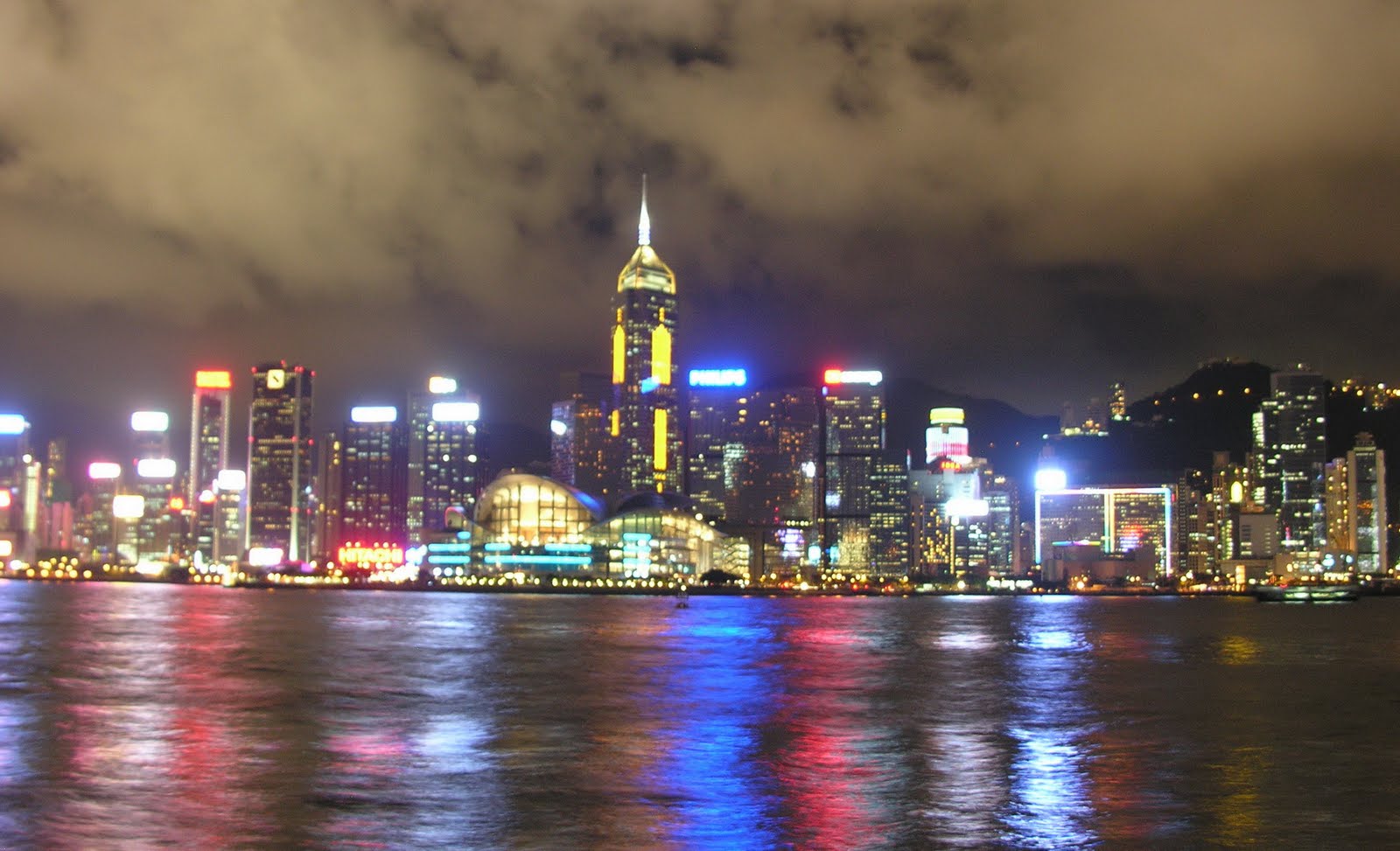
The famous Victoria Harbour is situated between Hong Kong Island and the Kowloon Peninsula to the north. Its deep, calm waters and strategic location on the South China Sea was instrumental in Hong Kong's establishment as a British colony and its subsequent development as a major trading centre.  Famous for its spectacular views of the Hong Kong skyline, Victoria harbour is the major tourist attraction of the city.  It was just five minutes away by walk from my hotel and that is where I spent the rest of the day.  I started with visits to the Hong Kong Science Museum and the Hong Kong Space Museum surrounded by a beautiful park.  There was one old beautiful clock tower of obvious heritage value.  I saw some spectacular harbour views in day light and waited for nightfall to see the magnificent Symphony of Lights, featuring more than 40 of Hong Kong's skyscrapers in a stunning multimedia extravaganza punctuated by dazzling laser lights of all colours.  The bad weather continued to follow me and dampened the enjoyment of the evening somewhat.  Here is a picture of the skyline I took during the night show with a hand held camera.  Notice the thick dark grey clouds spoiling the view significantly.
After exploring the neighbourhood a little more, including the famous Peninsula Hotel and an underground shopping complex, I walked back to the hotel for a good night’s rest after another busy day that had started early in the morning in far off Hangzhou.


The Peak


The Peak (popular name for the Victoria Peak) is a small mountain located in the western part of Hong Kong Island and has an altitude of about 550 m.  It is a major tourist attraction offering spectacular views of central Hong Kong, the high rise buildings, the harbour and the surrounding islands.  Public parks and posh residential buildings make the Peak a very attractive place.  It can be reached either directly by a circuitous road or by tramway.
I had planned to explore the Peak on the second day of my visit to Hong Kong.  I saw a tourist information office on the harbour, entered it and asked a smartly dressed lady at the desk for instructions on how to reach the Peak.  She welcomed me warmly, took out an excellent map of Hong Kong, marked out our location, explained how to get to the mainland by a short ferry ride, where to get a bus and the number of the bus that would take me to the foot of the tramway and how to reach the top of the Peak by tram.  She gave every bit of information I needed in some of the crispest and clearest language I have heard anybody speak.  For good measure she let me keep the map as well.  She was the very epitome of her profession. 
Armed with this information it was very easy for me to reach the Peak.  As the double-decker bus passed through the streets of the city I could see and photograph some of its finest buildings on either side. The bus stopped at one such building at the base of which the entrance to the tramway was located. The steep ride uphill in a vintage tram car was exhilarating. There were several spots at the top from which most of Hong Kong and its skyscrapers were visible in much better viewing conditions than on the previous day.  Here is a picture of me against the background of the skyline, the harbour and Kowloon:
Perching on the top of the Peak at 400 metres above sea level is the Peak Tower (see picture below) which is one of the most stylish architectural icons of Hong Kong. With an eye-catching design characteristic of the most modern architecture, this spectacular building stands out among the galaxy of impressive buildings in Hong Kong. Inside the Peak Tower, there is a dazzling array of shops, restaurants and entertainment halls set against the beautiful backdrop of the city. It boasts a 360° viewing platform - the Sky Terrace. Standing at 430 metres above sea level, the Sky Terrace offers breathtaking panoramic views of the city.
I spent practically the whole day at the Peak and was back at the harbour promenade for another view of the spectacular Symphony of Nights.  In between, I did a lot of window shopping in the shopping complexes around the harbour. 


Ocean Park


The Ocean Park is a vast area on the southern side of Hong Kong Island consisting of numerous conservation facilities, aquatic exhibits and enclosures as well as entertainment zones.  It has three major areas – the Lowland, the Headland and Tai Shue Wan – interconnected by a large network of cable cars (see picture below) and outdoor escalators.  At the ‘Amazing Asian Animals’ exhibit one can see some of Asia’s rarest animals, including the great giant Pandas, red Pandas, giant salamanders and alligators.  The dolphin show in a beautiful amphitheatre seating hundreds of spectators provides a special attraction several times a day.  There is a spectacular display of goldfish at the ‘Goldfish Treasures’ exhibit.  The Park is also the home for over a thousand sea jellies in a special enclosure.   The Ocean Park is committed to promote and support animal conservation in Hong Kong and throughout the Asia region. It has, in cooperation with other conservation organizations, launched various conservation programmes for a number of endangered species, including whales and dolphins. In addition, it has successfully bred rare species of birds, sharks and butterflies.

Guided by the map I had obtained at the tourist information office on the previous day, I took a bus ride to the Ocean Park.  Inside the park complex a friendly official approached me and gave some very valuable suggestions regarding how best to explore the vast complex and at what times I could see some scheduled events, including the dolphin show, for mass viewing.  My immediate interest was in the great Pandas for which a special climatically controlled large enclosure had been built.  I could easily three different types of Pandas from a distance and could even take a number of high zoom photos of these very rare animals.  Unfortunately, none of them came out well focused and this was a great disappointment.    So was my attempt to shoot the dolphins later in the day.  However, I could get some spectacular shots of the jelly fish.  Here is one of them:
The Ocean Park Tower was another special attraction.  People could stand on a circular platform which was slowly lifted up to a considerable height in a slow screw type motion, giving them a 360 degree panoramic view of everything in the neighbourhood. 
I spent practically the whole day in the Ocean Park and returned to the hotel room late in the evening.  For the first time on the China trip I indulged in some TV viewing.


Disneyland


I woke up on the last morning of my trip to China in anticipation of being back home by the following morning.  I had also decided to spend the day in sheer entertainment and relaxation at the famed Asian edition of Disneyland.  I had spent a whole day seeing the original edition of Disneyland USA in California way back in 1967.  So there was something special about this day.
The Hong Kong Disneyland is located on Lantau Island, not far from the International Airport, and could be reached from my place in Kowloon in about 40 minutes by a Mass Transit Railway (MTR) train.   I had to change over to the Disneyland Resort Line at the Sunny Bay Station and reach the very impressive Disneyland station a short distance away.  A short walk from the station took me to the main entrance of Disneyland, modeled very much on the lines of the original Disneyland as far as my memory could tell.  Bad weather continued to follow me and showed no special consideration for me even on my last day.
The entry fee was a whopping HK$ 350 and, as a senior citizen, I was lucky to get in at half this price.  When I reached the entrance there was a small crowd waiting for the gates to open.  This happened with much fanfare and ceremony at the stroke of 10 AM.  We were all welcomed into one of the magical worlds created by the great Walt Disney.    The entry into the park was through Main Street, USA, which gave a highly realistic feeling of being transported in both time and space to an idealized town in America long back.   The old world architecture was breathtaking in its beauty and everything appeared spotlessly sanitized.   From here one had the option to turn right to reach Tomorrowland or left to reach Adventureland or go straight ahead to reach Fantasyland.


“It’s a small world after all”


I first went through Tomorrowland for nearly two hours, but was not impressed much with the gadgets and exhibits that were designed more to dazzle than to educate.  Then I branched out into Fantasyland which was far more enjoyable as well as impressive.  I spent a much longer time there and felt transformed into a seven-year old, experiencing the sights, sounds and fantasies I had missed out when I was actually of that age.  The most memorable and lasting experience was in the “It’s a small world” pavilion in which the visitors are carried in self propelled boats through a long winding waterway surrounded by picturesque settings, performing ‘an imaginative journey around the world and experiencing the joy and wonder of creatively costumed dolls, elaborate sets, unforgettable music and for the first time ever, (ones) favourite Disney Characters’.  The animated singing dolls of all types in colorful costumes representing all parts of the world were absolutely fabulous.  This was fantasy at its glorious best, designed to bring out the child in every adult, however young or old.  For the seven to eight minutes during which the journey lasted I had totally forgotten myself and was like any other child around me.  The words and tunes of the magnificent song in English titled “It’s a small small world after all” still reverberate in my memory; the sights even more so. The reader can hear the song at the following website: http://disneynuts.com/smallworld.mp3.  The reader can also see any of several versions of the video clip available on YouTube.  However, nothing can ever match the joy, thrill and excitement of seeing the whole show in person at Disneyworld’s Fantasyland.  So much so that, after coming out of the show and ruminating over it in a mesmerized state for some time, I went back to experience it all over again, though it meant standing once again in a long serpentine queue.   I now regret not having done so a third time!  Such indeed was the effect it produced on me.  Here is a picture of the magical pavilion of the “It’s is a small world after all” show:
My last destination was Adventureland and the rain which had started as a drizzle earlier while I was in Fantasyland turned into a downpour and, like most others, I had to seek shelter wherever possible.  This prevented me from embarking on a Jungle River Cruise in a nearly open boat.  However I made it in time for the hour long Festival of the Lion King enactment in a large hemispherical theatre accommodating well over a thousand spectators in well designed galleries. It was billed as one of the great attractions of Disneyland and lived up fully to this reputation. 
It was now time to say goodbye to a delightful Disneyland, regretfully including what was for me at least its biggest attraction, the small world show.  I retraced my train journey back to my hotel, packed up and after a little rest, boarded a bus to the airport, this time with no problem about the exact fare.  I was poised to bid goodbye to a majestic Hong Kong with all its colonial legacy and glory.


Goodbye, China


At the Hong Kong airport I exchanged all the left over small change with me for a large cold milkshake, went through the exit formalities and boarded the Dragonair jet for a nonstop flight to Bangalore.  As the aircraft taxied out and picked up speed the memories of the past thirteen days flashed through my mind at matching pace and I bade a silent goodbye to China.  In flight I was once again served an excellent vegetarian dinner and, after a four hour journey with some discomfort caused by air turbulence only towards the approach to Bangalore, landed five minutes before time at the Bangalore airport late in the night or, more appropriately, very early next morning.  I was back home at Mysore after a short overnight stay in Bangalore.  Thus ended the most memorable overseas visit of my life.


Epilogue


When I first contemplated my trip to China I was arrogant enough to rationalize that the only reason I had for going to that country was to view the total solar eclipse on the morning of 22 July 2009.  My early experiences in Beijing were humbling enough for me to realize that there was a great deal more to do in China than just see the eclipse.  I learnt this lesson from the ordinary people of an extraordinary country that has achieved what is undoubtedly the greatest economic miracle of our times and is a super power in every sense of the term.

Blog Archive