My
discovery of a bird’s nest in my backyard and the subsequent developments were
narrated in a pictorial story last month [See: http://drsnprasadmysoreindia.blogspot.in/2012/06/birds-nest-and-its-hapless-habitants.html].
After the quick and tragic end to the story, little did I anticipate
that I would be reliving it over a much longer period, this time with a
mysterious rather than a tragic ending.
Here is what happened, again supported by a faithful photographic
documentation.
My
daughter and grandson had joined me again for an extended summer holiday, and
their curiosity had led them one day to peep inside the flower plant where they
had made their earlier discovery. This
time they saw a brand new empty nest, a little deeper and higher inside than
last time, ready for occupation. It was early
morning on 26 June. When they showed it
to me, I again reacted instinctively with camera in hand and shot my first
picture of the nest. We kept looking for
further developments discretely every now and then. Here is a picture of the empty nest I shot on
29 June, fully ready for occupation:
[Many of the
pictures shown here are in high resolution and can be blown up to their full
size by clicking on a picture and opening it in a separate window]

It
was delightfully unsurprising for us to discover a lone, beautifully mottled
egg inside the nest the same afternoon. Below
is my first picture of it. Not only was
the egg by itself a splendid sight, equally so was the marvelously intricate
structure of the nest itself that I had a chance to examine for the first time.

Not
unexpectedly, we found a second egg beside the first one the very next
morning. Here they are, lying side by
side in the dull early morning light.

When
I saw the two beautiful eggs together I was strongly tempted to snatch one of
them and preserve it as a memento in my showcase. In the light of my earlier experience I must
have rationalized that it would not be a horrendous loss to the avian community
if I did so. However, it didn’t take me
more than a moment to exorcise this devil in me and let nature play out its own
plot.
We
had a feeling that our as yet unseen avian visitors were familiar with our
household and could even be the same duo that had set up home in our premises
earlier. Our suspicions were confirmed
by our first sighting of a red whiskered bulbul close to the nest as captured
in the following picture:

Here
is an ultra-zoom picture of the visitor taken soon after, perhaps contemplating
its next move in a not too friendly mood:

For
the next ten days in a row, we observed one of the parent birds sitting in the
nest and incubating the two eggs, while the other bird kept watch and vigil
nearby most of the time. Unlike the
previous occasion, none of their avian friends were ever in attendance. Also, our backyard always exuded a serene
atmosphere, with the birds strangely quiet most of the time. Our knowledge of ornithology was far too
elementary to identify the two birds by their respective gender, but this
hardly mattered. Here is one of scores
of pictures I took of one of the parents snugly inside its nest warming up the
eggs during this long incubation period:

It
was on the evening of 10 July that we got a glimpse of one of the freshly
hatched baby birds cutely embracing its unborn sibling still in its nest. Here is this intensely tender picture:

Unfortunately
we couldn’t get to see the hatching process itself, nor could we see any of the
broken pieces of the eggshell after the baby had come out. Presumably, one of the parent birds had
deftly cleaned up the debris. This whole
thing was repeated the next day when the second egg was also hatched. We would have dearly loved to steal a glimpse
of how the baby was coming out, hopefully even being able to capture it on
video, but this was not to be. Such a
video clip can however be viewed from a well-known source, the Internet Bird
Collection, at: http://ibc.lynxeds.com/video/red-whiskered-bulbul-pycnonotus-jocosus/red-whiskered-bulbul-parent-feeding-cleaning-babies
Here
is a picture of one of the parent birds apparently in the process of hatching
the other egg even as it was taking care of the newborn one:

As
could be expected, it was the very next day that the second egg also hatched
and I was able to take the following picture with the two baby bulbuls with
their ‘arms’ around each other:

The
parent birds had intensified their vigil and rarely did we see one bird not
watching nearby while the other one was crouched over the baby birds in the
nest, not only protecting them but presumably also, feeding them. Rarely did we get an inkling of how this was
being done. We desisted from observing
our visitors too closely and too frequently or intrusively, fearing that we
might disturb the natural processes where human interference is so alarmingly
on the increase in our modern ‘civilized’ world.
Occasionally
we observed both the parent birds next to each other on a cable overhead while
the baby birds were left to themselves in the nest. Here is a picture of one such situation:

Here
is a picture of the two baby bulbuls when left alone, with one of them
apparently hollering hoarsely for something, may be for mama bird, or for food
or both, while its sibling appears to be blissfully asleep:

Early
next morning I caught one of the birds overseeing the nest and its little
sleepy habitants:

It
was not until 24 hours later (on 13 July) that I got an opportunity to shoot a
picture of one of the birds holding some food with its beak in readiness to
feed the babies. Seen in the following
picture, the food appears to be a dead grasshopper. This was the only time I could catch anything
close to the actual feeding of the babies.
Of course it must have been happening frequently, without any luck for
us.

The
next picture shows the two baby birds lying next to each other with
unmistakable signs of feathers. In our
earlier experience with the birds the little ones had fallen prey to a predator
long before this stage had been reached.
This gave us some hope that they could survive such an eventuality this
time. My initial hopelessness had made
way for some guarded optimism.

Though
we were not lucky enough to observe the actual feeding process, we saw the
parent birds frequently carrying something or other dangling from their beaks,
obviously intended for the babies to eat.
Here is one such instance captured while a parent bird was perched on
the overhead cable:

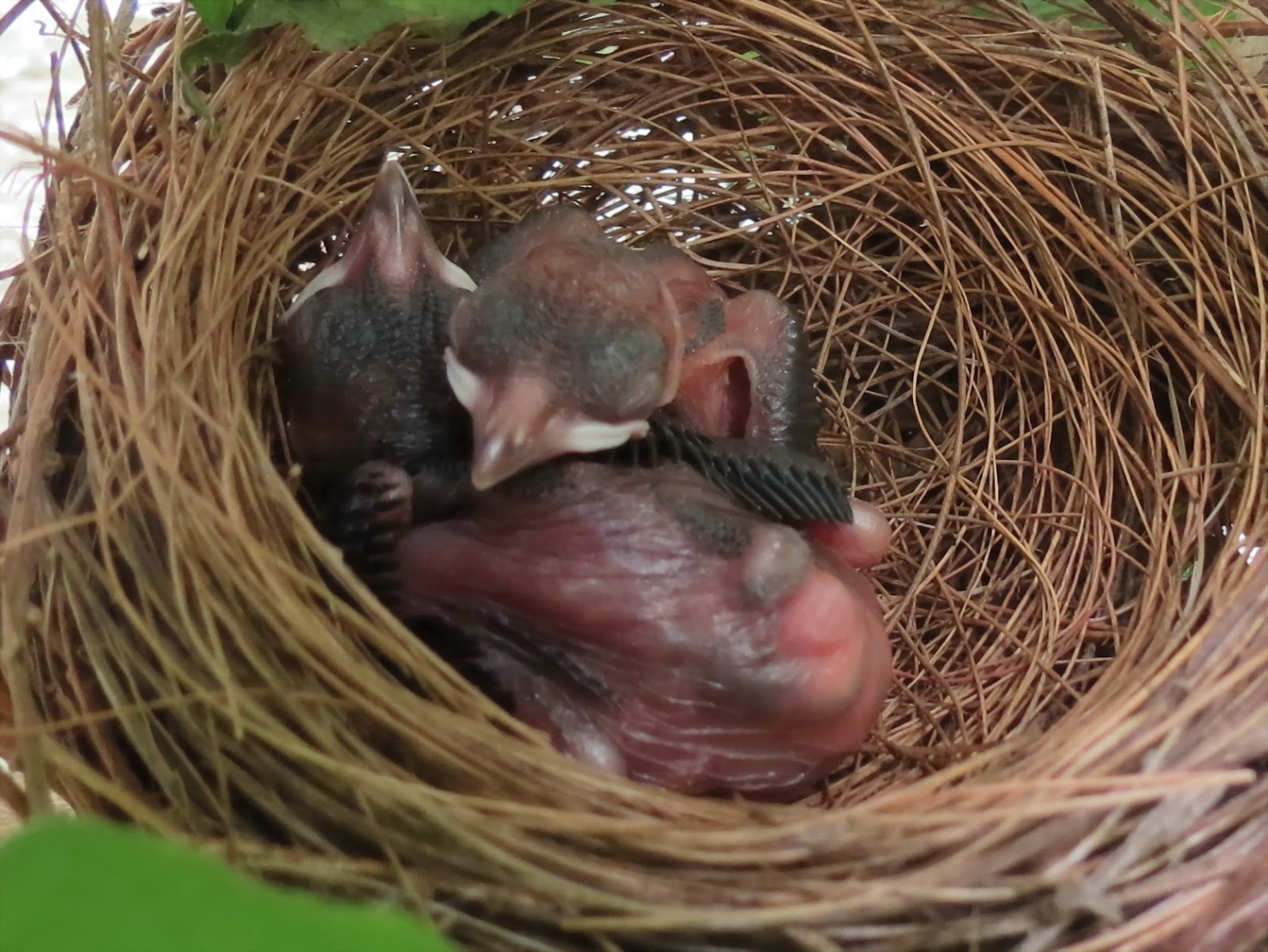
The
next picture shows the babies in the nest, one of them in the act of crawling over
the other, both in excellent shape.
Now
comes the mystery side of my story. The
following is my last picture of the baby bulbuls huddled in their nest, with
both parents standing guard somewhat as usual on the cable overhead.

I
shot this picture just before I had my lunch on 14 July, just under five days
after the first egg had hatched. In
retrospect, when I now reflect on this picture, the babies appeared to have
such well-developed wings that I felt it would be a matter of just a few days
before they would be on their own and be able to even leave the nest. However, it was still a great surprise for me
to discover an empty nest later in the afternoon that day.
My
initial reaction was one of shock and sorrow just as on the previous occasion,
but I realized very soon that the two situations were quite different. Here I was staring (see picture below) at a
nest that was in as good a condition as when we first noticed it and at any
time thereafter, with no tell-tale signs of any intrusive activity. In contrast, what I had seen on the last
occasion was a nest that had been violently attacked and trampled upon, with
its hapless habitants almost certainly killed and carried away. Here I got the impression that the babies had
been helped away to a safer place by the parents sometime that afternoon
without any of us in the household noticing the act.

So,
now I have a mystery behind the missing bulbuls. Unlike last time, circumstantial evidence
indicates that they survived and may have been helped to a safer location by
the parents who were seen going about their daily business for the next 2-3
days as if nothing untoward had happened.
However, ornithology experts may have a different and a less optimistic explanation. For my part, for sheer lack of understanding, I
would like to trust my instincts for once and assume a happy ending to my
story. Sometimes ignorance can be
bliss!

