Thursday, October 14, 2010

Jaipur, the Pink City – Personal Photo Album Part 3

Delhi, Agra and Jaipur constitute a ‘Golden Triangle’ of cities forming a major tourist attraction in India.  My official duties used to take me to Delhi quite frequently and I was able to explore its tourist attractions in fair detail several times.  On a few such occasions I also managed to visit Agra which hosts one of the seven man-made wonders of the world.  This was the subject of my earlier blog post dated 27th August this year.  I did not get a chance to visit Jaipur, capital of Rajasthan state and popularly known as the Pink City, until 3rd August 2005 on my way back to Delhi from an official visit to Ajmer.  I had waited far too long for such an opportunity and needlessly so.  Since I didn’t have adequate time for a leisurely walking tour of the city, my preferred style of sightseeing, I opted for a whole day conducted tour offered by the state tourism board.  I have never really liked conducted tours for various reasons, one of them to do with the poor professional quality of the guide.  The Jaipur tour was a major exception since I and my fellow tourists ended up in the hands of an exceptionally competent and knowledgeable guide.  He was very young, dynamic, friendly and could speak English quite fluently, something rather hard to come by among official departmental guides. 
   
The Pink City was founded in 1727 by Maharaja Sawai Jai Singh II, an extraordinarily enlightened ruler by any standards. He was also a famous astronomer and founded the great medieval astronomical observatory, called Jantar Mantar, at both Jaipur and Delhi, the one in Jaipur being larger and better known.  What he accomplished in India has some modest similarities to the achievements of the great Danish nobleman and astronomer Tycho Brahe in 16th century Europe. The city itself is steeped in Rajasthani history and culture as well as some distinctive architecture.

[All pictures in my posts can be blown up to their full size by clicking on a picture and opening it in a separate window]

Amber Palace

The main attraction in Jaipur is the palace located in the sprawling Amber Fort on a rugged hillock about 10 km from the city.  Here is a picture of the fort across a water way as we approached it:

Here is a view of the quadrangle inside the fort complex with a flock of pigeons enjoying their freedom:

The following is a view of the palace from the interior.  The architecture is similar to the ones seen in Agra and Delhi forts.

Pictured below is Ganesh Pol, the ornate entrance gate to the Amber palace, a stunning mix of Mughal and Rajasthani architectures.

Here is a blown-up view of the lower right portion (on the ground floor) of the previous picture showing its strikingly beautiful painting and inlay work:


Albert Hall Museum

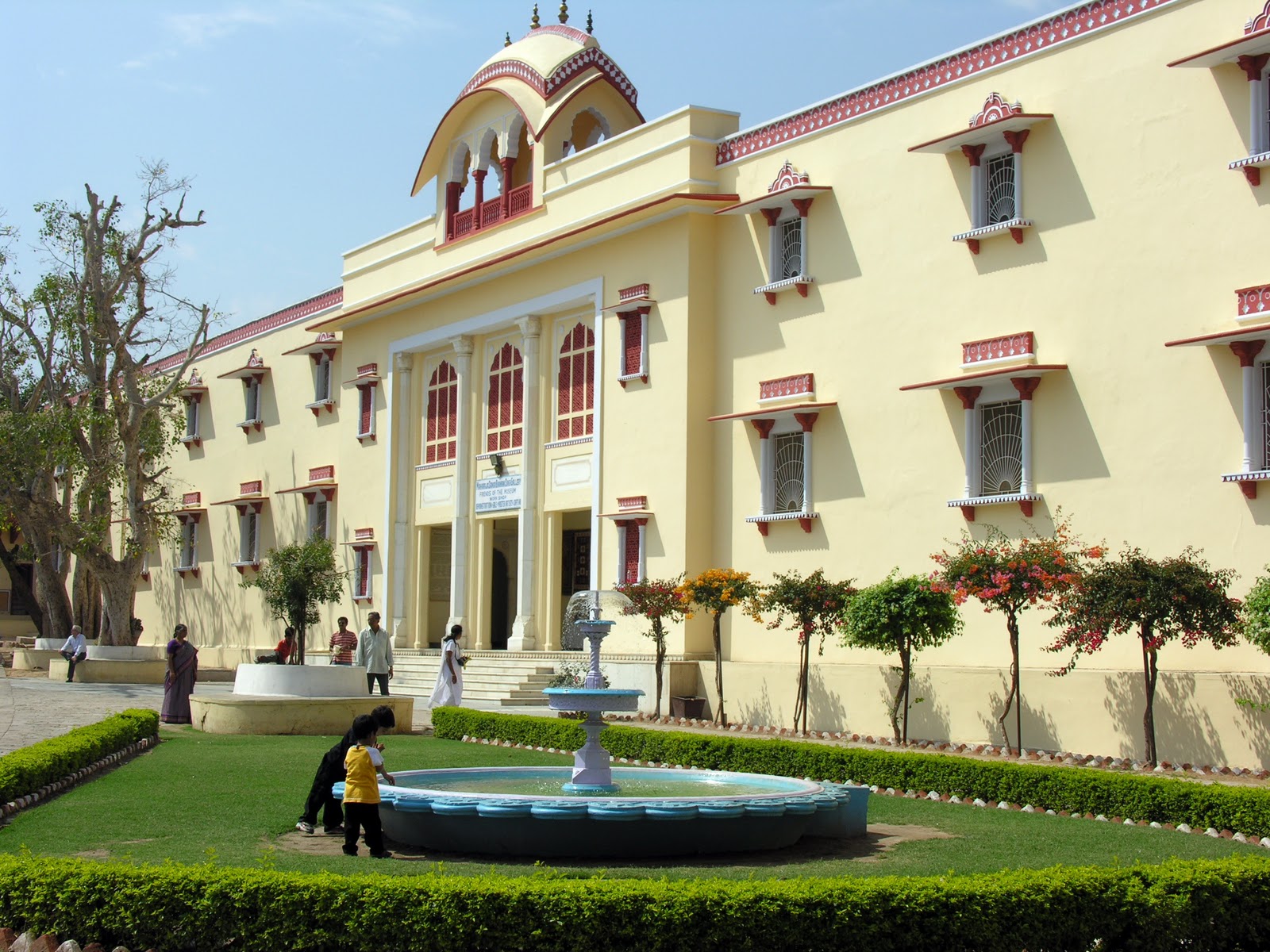
The Albert Hall Museum, conceived on the lines of the famous Victoria and Albert Museum in London, is one of the oldest museums in the country.  Surprisingly, the tour itinerary did not include a stop here and I had no chance to get a good picture of the excellent heritage building housing it.  However, I managed to shoot a zoomed-in picture of its uppermost part capturing its stunning style and architecture.  Here it is:

The Hawa Mahal

The Hawa Mahal is the most popular landmark of Jaipur and in some ways symbolic of the city itself.  Abutting a busy street in the heart of the city, its uniquely rich exterior is in sharp contrast to a drab and dull interior.  The tourist bus slowed down sufficiently for me to capture this image of the famous structure without having to get down:

Jaigarh Fort

The Jaigarh Fort, also known as the ‘Victory Fort’ is located on top of a hill about 15 km away from the city and quite close to the Amber Fort.  Here is a view of this sprawling fort complex:


The Jaigharh Fort houses what is claimed to be the world’s largest cannon.  To see this, one has to pay an additional entrance fee!  Here is a picture of this fabled cannon:


Nahargarh Fort

Located north of Jaipur city, the Nahargarh Fort lies atop a rugged hillock and commands a great view of the city all around.  Here is a picture of the older and rather dilapidated portion of the fort in the foreground against the backdrop of part of the city:


The later additions to the fort are much better preserved and house a number of beautiful structures. Here is a spectacular view of the intricate and colourful ceiling of one of them:


Here is another view of the pink city from a vantage point on the fort. The triangular structure prominently visible at the central right portion of the picture is part of the famous Jantar Mantar, the astronomical observatory built by Sawai Jai Singh. 

 
Jantar Mantar

The Jantar Mantar observatory complex houses a number of large geometric mechanical devices mostly made up of stone for measuring time, tracking stars and planets, predicting eclipses and measuring celestial coordinates to a high degree of accuracy without employing any optical aid as in modern astronomical observatories.  Preserved in very good condition, Jantar Mantar has been declared a world heritage site.  Here is a picture of the largest structure, the majestic Samrat Yantra (easily recognizable in the previous picture), whose steep edge is at an angle of just under 27 degrees to the horizontal plane, corresponding to the latitude of the place.  It points north along the earth’s axis and the device is part of what is considered to be the world’s largest sundial.   


Our guide spent a good bit of time at Jantar Mantar explaining quite competently how the various instruments in the observatory were designed to be used.  Most of what he said fell on deaf ears and I appeared to be the only tourist showing any interest in his narrations. The invisible bond between us grew stronger.

Jal Mahal

The Jal Mahal is a beautiful palace surrounded on all sides by the picturesque Mansagar lake against the backdrop of the Nahargarh Fort.  Here is a picture of this taken from the roadside:


City Palace 

One of the major attractions of the pink city is the City Palace Complex which has a number of spectacular and palatial buildings, with a great museum as its centerpiece.  Here are two pictures from inside this complex:

The Birla Connection

The influence of the Birla group in the Pink City is underscored by two of the most famous modern buildings in the city – the Birla Mandir and the Birla Science and Technology Centre. 

The Birla Mandir (Laxminarayan Temple) built in 1988 out of pure white marble like the one in Hyderabad, is a stunning sight during both day and night.  At the foot of the Moti Dungri Fort housing former royalty, it is surrounded by lush greenery and large open spaces.  The following picture of the temple is particularly pleasing against the background of a blue sky with white clouds.  The carvings on the outside can be best seen when the picture is blown up to its full size. 

Here is a picture of the main building forming part of the famous Birla Science and Technology Centre which also houses a modern planetarium, in some respects complimenting the ancient Jantar Mantar.  It is a stunningly modern building with a breathtakingly beautiful architecture. 


Au Revoir Jaipur

The daylong tour of the Pink City and surroundings was really long and a warm weather added considerably to the discomfort of the tourists.  The trip should have terminated at the Birla Planetarium with a celestial show, but most tourists were in no mood for it and dropped out along the way.  I and the indefatigable guide were the only ones who reached the destination, but I opted to spend the rest of the day outdoors rather than inside a planetarium which was no stranger to me.  Before leaving, I paid a sincere and richly deserved compliment to my guide for all that he had done to make the day so memorable.  On his part, he paid me an equally rich compliment by saying that at twice his age I was hardly the kind of tourist he was used to meeting.  Even as I compose this post I greatly regret my thoughtlessness in not having written a formal letter of appreciation to the state tourism board for providing such an exceptionally able guide.

Thursday, September 16, 2010

Education for Sustainable Development

[I had delivered the following keynote address at a conference of heads of teacher education institutions in Karnataka about two years ago in Bangalore.  In view of its perennial relevance and importance, I am reproducing it in its entirety here, with two visuals inserted for added effect]


Education for Sustainable Development
Issues and Concerns for Teacher Education


The World Commission on Environment & Development (WCED, 1987)(1) , better known as the Brundtland Commission after its famous chairperson and former Norwegian Prime Minister Gro Harlem Brundtland, described sustainable development as one that “...meets the needs of the present without compromising the ability of future generations to meet their own needs”.  In the language of kindergarten teachers, this might simply mean; “Don’t take more than your share!”  Mahatma Gandhi addressed the issue with his characteristic eloquence and directness when he said; “Earth provides enough to satisfy every man’s need, but not every man’s greed.” 
 
Sustainable development is one of the major goals of Environmental Education (EE) that has become a vital part of education at all levels in recent decades – for students, teachers, teacher-educators and indeed for all citizens of all nations.  In India, EE received a huge boost from a landmark Supreme Court judgment in 2003(2) calling for the ‘compulsory introduction of EE as a subject at all levels of education, including courses leading to the first and second degrees’. It reflects rather poorly on the educational system of the country that it had to be stirred into action by such a judicial intervention without taking proactive measures to address the issue on its own initiative. 

The Constitution enjoins the state to take measures to protect and improve the environment and to safeguard the forests and wildlife of the Country (Article 48-A). The Constitution also makes it a fundamental duty of every citizen ‘to protect and improve the natural environment including forests, lakes, rivers and wildlife and to have ecological compassion for the living creatures’ (Article 51-G).  These constitutional provisions make sense only when taken in consonance with another fundamental duty expected of all citizens, viz. to develop a scientific temper, humanism and the spirit of inquiry and reform.  In this context it is relevant to remind ourselves that EE is a process aimed at ‘developing a world population that is aware of and concerned about the total environment and its associated problems and which has the knowledge, attitudes, commitments and skills to work individually and collectively towards the solution of current problems and prevention of new ones’.

In the formal education sector in the country, EE is a significant part of the curriculum at all stages of schooling.  It is a multi-disciplinary area of study and its scope is very broad based, encompassing physical, chemical, biological, social, cultural and human dimensions of study.

The ecosystem comprising the entire earth and the living organisms that inhabit it is called the biosphere.  The vital role of the biosphere in human affairs can be gauged from two statements made by Anthony Cortese, founder and president of the Sustainability Education Organization called Second Nature: “The economy is a wholly owned subsidiary of the biosphere” and “The biosphere provides everything that makes life possible, assimilates our waste or converts it back into something we can use.”  But there are limits to how much the flexibility of the biosphere can be exploited and we seem to be getting dangerously close to these limits.  

As far back as 1972, the possible consequences of a rapidly growing world population and the finite nature of the resources to support it were examined in a seminal study published under the title “Limits to Growth” (3).  A recently updated study (4) comparing the past thirty years of reality with the predictions made in 1972 finds that changes in industrial production, food production and pollution are all in line with the book's predictions of an economic collapse in the 21st century.  We are indeed heading towards a catastrophe in this century if we continue to exploit our planet’s resources recklessly, focusing on development without addressing the intertwining issue of its sustainability for future generations.

The National Policy on Education (1986) and the National Curriculum Frameworks (1975, 1988, 2000, and 2005) have always emphasised EE at all levels of schooling, graduating from an exploration of the environment at the primary stage to studying the larger social and economic implications of the human-environment interaction at the secondary stage.  ‘Environmental Studies’ was made an independent subject at the primary level and topics related to environment were suitably infused with different general science and social science subjects at all stages of schooling. 

Institutions of teacher education are looked upon as major agents of transformation in the global education scenario as they have the potential to bring about changes within educational systems that can promote, among other things, education for sustainable development (ESD) and influence future generations.  In India, this expectation has to be greatly tempered with the realization that the quality of teacher education has suffered severely due to an uncontrolled and epidemic growth of institutions in recent years.  However, the pre-service teacher education curriculum itself looks good on paper and has been updated to provide the basic knowledge and conceptual understanding of EE as well as to develop relevant skills and attitudes.  A matching effort in educating in-service teachers is a crying need and requires a massive programme of action.  It is hoped that institutions of higher education in the country will address this issue head on and come up with viable action plans.

Environmental Education is a process aimed at developing a world population that is aware of and concerned about the total environment and its associated problems and which has the knowledge, attitudes, commitments and skills to work individually and collectively towards the solution of current problems and prevention of new ones. The major goals of EE are: (i) To enable people to understand the interdependence of all life on this planet, and (ii) To increase people’s awareness of the economic, political, social, cultural, technological and environmental forces which foster sustainable development.

The first inter-governmental Conference on EE held at Tbilisi in 1977 (5) established the objectives of EE. These are to develop the following qualities in individuals and social groups:

  • An awareness of the environment and its problems.
  • Basic knowledge and understanding of the environment and its interrelationship with man.
  • Social values and attitudes which are in harmony with environmental quality.
  • Skills to solve environmental problems.
  • Ability to evaluate environmental measures and education programmes.
  • A sense of responsibility and urgency towards the environment so as to ensure appropriate actions to solve environmental problems.
Some guiding principles for any curriculum of EE should include the following:

  • Consider the environment in its totality.
  • Treat EE as a continuous lifelong process.
  • Bring to bear an interdisciplinary approach to EE.
  • View EE with an international perspective, even while focusing strongly on local issues and cultural appropriateness.
  • Accommodate the evolving nature of the concept of sustainability.
  • Focus on the well being of all three realms of sustainability – Environment, Society, and Economy.
  • Encompass all forms of education – formal, non-formal and informal.
  • Ensure cooperation at all levels and with all stakeholders.
  • Consider environmental aspects in all developmental plans.
  • Ensure true participatory learning.
  • Emphasize the complexity of environmental problems
  • Bring in a broad array of educational approaches.
In 2005, the UNESCO published an important document titled “Guidelines and Recommendations for Reorienting Teacher Education to Address Sustainability” (6).  It is still good enough to guide any efforts towards developing/reforming teacher education curricula in ESD/EE.  The basic strategies required for strengthening both pre-service and in-service teacher education programmes are:  (i) Reviewing and modifying the existing pre-service and in-service teacher education programmes in view of the need for making ESD/EE an integral part and providing theoretical and practical inputs specifically focusing on environment related issues and concerns; and (ii) Familiarizing teachers and student-teachers with planning, organizing and conducting projects, activities and case-studies in EE and enabling them to generate desired action amongst learners.  This document contains appropriate recommendations pertaining to the following areas:

  • Ministerial & National Involvement
  • Community & Regional/Provincial Involvement
  • Change within institutions of Higher Education:
a) Across institutions of Higher Education
b) Within faculties of Education
c) Pre-service & In-service teachers
d) At the level of individual faculty member
  • Funding and other resources
  • On developing partnerships
  • On the need for meaningful and productive research in ESD/EE
  • On communications among all stakeholders
  • Information Technology Opportunities

University departments of education and institutions for higher education need to take up and promote a vigorous programme of research addressing all aspects of ESD/EE and at all levels of education.  These should be able to provide evidence and experience based inputs for a continual exercise of curriculum review and renewal in schools and colleges. Most importantly, such curricular interventions should be able to produce, in the not too distant future, a reversal of the current process of environmental degradation and an observable and measurable impact on the quality of the environment for future generations.  This should be the guiding principle for any vision of ESD in the 21st century.  Let us all join together to preserve, protect and defend our environment – whatever is left of it!


References:
  1. Our Common Future, Report of the World Commission on Environment and Development, World Commission on Environment and Development, 1987. Published as Annex to UN General Assembly document A/42/427, Development and International Co-operation: Environment August 2, 1987
2.   Supreme Court of India Directive in M.C. Mehta vs. Union of India and Others, SOL Case No. 865, 2003
  1. The Limits to Growth. Donella H Meadows, Dennis L Meadows, Jorgen Randers, and William W Behrens III (1972);New York: Universe Books
  2. Limits to Growth, the 30‑Year Update (2004); Donella Meadows, Jorgen Randers, Dennis Meadows
  3. Intergovernmental Conference on Environmental Education, Tbilisi (USSR) 1977; UNESCO & UNEP
  4. Guidelines and Recommendations for Reorienting Teacher Education to Address Sustainability; Education for Sustainable Development in Action, Technical Paper N° 2 – 2005, UNESCO Education Sector
7.   Strategies in Environmental Education - Experiences from India; K V Sarabhai; International Meeting of Experts in Environmental Education, Spain; UNESCO November 2000.
8.   Education for Sustainable Development Toolkit; Rosalyn McKeown; July 2002; Energy, Environment and Resources Canter University of Tennessee, USA.
9.   Indian Initiatives in Environment Education; Rajaram S Sharma; RIE Mysore

Friday, August 27, 2010

Wah! Taj – Personal Photo Album Part 2


The Taj Mahal has always been regarded as one of the great wonders of the world and hence its inclusion in the official list of “New Seven Wonders of the World” in 2007 was only a formality despite the fact that the selection was by popular voting.  I was one of the more than one hundred million voters and had placed this at the top of my list.  The official list includes the Great Wall of China which I had the good fortune to visit last year (see my ealier blog titled “China Diary Part 1”) and the Coliseum in Rome which I had visited in 1967.  The other four in the list are: Chichen Itza in Mexico, Christ the Redeemer in Brazil, Machu Picchu in Peru and Petra in Jordan.
When I first saw the Taj Mahal way back in 1963, I was dumbstruck by the sheer grandeur and beauty of the famed monument.  It made an impact on me far exceding the expectations aroused from my gleanings of the architecture and history of the Mughal period in India.  What struck me most was the perfect proportion and symmetry between different parts of the monument, especially in relation to the huge central dome, as well as its surroundings.  Because of this, one doesn’t really perceive how gigantic it really is, something that shows up very conspicuously in two of my close-up pictures presented later.   I had read great descriptions and seen some breathtaking pictures of it, but these faded away in comparision with the sight of the real thing, a magnificient marble mausoleum built as a symbol of eternal love by an opulent and indulgent monarch.   Unfortunately at that time, I was yet to get hooked on to photography as a hobby and have nothing to show for my experience.  The next time I went to see it many years later with a cemera, the monument was enveloped at several places by some rather ugly scaffolding for major repairs and was not worth photographing.  At the third time I went to see it, my photographic interests had gone into hibernation.  My real opportunity for some serious photography came only relatively recently, in February 2005, when I visited Agra on a ‘guided’ tour from Delhi. This time I was well armed with a recently acquired Nikon Coolpix 8800 digital camera offering 8 MP pixel resolution and 10x optical zoom.
Agra Fort   
Although the tourist bus had left Delhi as early as 7 AM, it was lunch time when it reached Agra and the driver took us straight to a third rate restaurant charging  top rate prices for lunch.  It was well into the afternoon when the bus reached Agra Fort where I detatched myself from the rest of the tourists and began my own exploration with my camera in full readiness. The weather was bright and sunny and I realized I could get some very good pictures during the rest of the evening.
The huge red brick fort is a formidable structure enclosing several palatial marble buildings and even more impressive than the Red Fort in Delhi; both are UNESCO designated world heritage sites.  Here is the entrance to it through the main gate over a small bridge across a moat:
[All pictures in this post can be blown up to their full size by just clicking on them and viewing them in separate windows]
Inside the Fort
One has to pass through another huge gate before reaching the vast interior.  Here is an angular view of one of the buildings, called Jahangiri Mahal, with a large lush green lawn in front:

The Diwan I Am (Hall of Public Audience) seen in the following picture is very similar in appearance and purpose to its equally impressive counterpart in the Delhi Red Fort.

Here is an angular view of the Khas Mahal with a vast ornate garden in front.  The garden has a symmetrical counterpart in front of the building.

The structure seen in the following picture and just noticeable in the previous one has a poignant association with Emperor Shah Jahan who built the Taj Mahal.  He had been overthrown and imprisoned in the Agra Fort by his despotic son Aurangzeb.  Shah Jahan is said to have spent his last days fondly viewing the great edifice visible from here on the banks of river Yamuna.  The picture captures it right at the centre though not very clearly.   It can be seen much clearer if the picture is blown up to full size.

Oh! The Taj
In the next picture I have captured the whole of Taj Mahal from the balcony of the above building with the camera on full zoom (89 mm focal length).  This picture reveals a lot more than it shows.  While it captures the entire building from a distance of about 2km, it also captures the incredible filth and the squalor lying around the river bed between the Fort and the Taj which happen to be two of the most impressive sights in the world.  What a contrast! What an irony! What an invitation to a grand stand view of one of the greatest wonders of the world!  You will have to blow up the picture to its full size to understand what I mean (just click on it and wait a little while for everything to show up).  Mercifully, this is not the view Shah Jahan would have seen; he certainly deserved not to.

Interestingly, the early part of one of Conan Doyle’s great mystery novels, The Sign of Four featuring Sherlock Holmes, is set in the Agra Fort.  Having read the novel, I tried to relate the pertinent part of the story to the Fort, but found no sign that Doyle had any first hand knowledge of it.  After all, it was only fiction.
The Taj
To improve the quality of air around the Taj complex, the authorities do not allow any motorised vehicles to approach it within a certain distance.  This concern does not seem to extend to the area just behind the monument on the banks of the river.  Nobody seems to mind all that filth and squalor.  On the way to the Taj, tourists have to get down at a designated point and either walk up to the complex or take an expensive electric vehicle.  While this is certainly laudable, what follows is just the opposite.  Once the tourists reach the entrance to the complex they are subjected to some of the stiffest and most irksome security checks anywhere in the world.  This is quite an ordeal and dampens their enthusiasm in no small measure.  The one saving grace is that cameras are allowed unlike many other tourist attractions in the country.
Foreign toursits, who are identified only by their appearance, have to cough up a hefty entry fee which is about fifty times what their Indian counterparts have to pay!  Such discrimination, not to speak of the sheer scale of it, is a monumental insult to the injury already inflicted on tourism in the country by way of poor facilities.  Nowhere in the world have I come across such discrimination against foreign tourists.  This is quite shameful for a country like India which is among the least popular tourist destinations in the world.  During my sight seeing visits in China last year, I did feel that the entry fees in most places were unreasonably high, but they were no more than what the locals had to pay.  Also, there were no restrictions of any kind on photography.
One enters the Taj through its main gate in a massive red brick building (see picture below) which is in itself a great sight.

Standing at the entrance gate, the sight of the great marble monument at the far end of two long pathways on either side of a waterway is a breathtaking experience.  As one steps inside, the whole of the complex with its rich greenery and gardens comes alive.  I wanted a photograph of myself highlighting the monument in the background and was lucky enough to find a foreign visitor who understood exactly what I wanted and shot this picture for me with my won camera.  Of course he couldn’t avoid the conspicuous people nearby and the not so conspicuous ones farther away.  I have cropped the picture to make it more presentable, shifting the attention to the monument as much as possible. It is one of my prized possessions.

The following two photos from a close range indicate how gigantic and impressive the monument really is:

At one place on the periphery of the quadrangle I saw the huge dome of the monument behind the beautifully bare branches of a tree and captured the combination, a creation of nature blending with one of man.  Here it is – one of my best photographs of the day.   It can be better appreciated when seen in full size.
 
My last picture here was aimed from the elevated platform in front of the monument towards the entrace gate and captures the wonderful central waterway, the long pathways and gardens on either side of it and parts of the greenery elsewhere.  The entrance gate also stands out in all its glory.

Au Revoir
After the short but memorable visit to Agra the tourist bus took us on a night time visit to Mathura and returned to Delhi well past midnight.  I wish I had spent a much longer time at the Taj.  I could have done so only if I had stayed in Agra for a day or two.  This is what I intend to do during my next visit wehenever it be.  Till then I will continue to cherish the memory of my last visit.

Monday, August 16, 2010


Tagore and Einstein on Music


Rabindranath Tagore met Albert Einstein on 14 July 1930 near Berlin during his visit to Edurope and exchanged views with him on a variety of topics with the help of a mutual friend.  Here are excerpts from their conversation on music, an area of common interest.

Foreword

During the formative phase of my professional career in the late sixties at the Regional College (now, Institute) of Education in Mysore, Professor Praful N Dave was my mentor and a major influence on me. He taught me the principles of educational evaluation through Bloom’s taxonomy as well as his own modified version. More significantly, he introduced me to the wonderful world of western classical music through his impressive collection of LP records. I got hooked to the compositions of great masters like Beethoven, Mozart, Bach, Strauss, Tchaikovsky and a host of others and developed an abiding interest in them. I built up a small collection of taped western classical music and used to listen to them whenever possible. Beethoven’s seventy minute long Ninth Symphony was, and still is, my most favorite piece of music and I have listened to it with the greatest of joy a countless number of times.

Once long ago, while traveling with three friends in a first class railway compartment in central India, one of them persuaded his Bengali friend to entertain us with some music in his native language. This person, rather reclusive up to that time, opened out with a few pieces of Rabindra sangeeth which enthralled me greatly with its distinctively melodic style and depth of feeling though I could not understand any of the words making up the music. This was my gateway to Rabindra sangeeth which I have enjoyed ever since, as much as western classical music, though these are poles apart.

My interest in Rabindra sangeeth received a huge boost from my esteemed friend and former professional colleague, Professor Somnath Datta, and his wife, who are both strongly addicted to all forms of Rabindra sangeeth, especially Tagore’s great dance dramas. I have attended a number of sittings at their home and listened to their orchestral duets. I still don’t understand most Bengali words, but this has certainly not hampered my enjoyment of this great form of music. With their help I have built up a small collection of Bengali music to add to my collection of western classicals.

In between, my liking for and interest in the traditional Hindustani style of classical Indian music has also grown considerably. I enjoy listening particularly to the vocal renderings of great masters like Paluskar, Jasraj, Bade Ghulam Ali Khan, Gangubai Hangal, Mallikarjun Mansur, Bhimsen Joshi and a host of others belonging to a rich variety of styles or Gharanas. Needless to say, I have built up a good collection of Hindustani classical music as well.

In 2005, which marked the hundredth anniversary of Einstein’s great discoveries in Relativity and Quantum Physics that heralded what is perhaps the greatest revolution in human intellectual history, I had to dig up information about Einstein’s life as well as his work for a series of lectures to students and teachers of physics. I stumbled upon an article* summarizing the conversations that took place in Germany during two meetings of Rabindranath Tagore with Albert Einstein. Music being the obvious common factor connecting these two extraordinary stalwarts of the twentieth century, a considerable part of their conversation was centered round the similarities and differences in the western and Indian classical styles of music. In view of my great admiration for both of them, one for his revolutionary work in science and the other for his lasting contributions to music in particular, I read this article with tremendous interest. I had casually mentioned this to Prof Datta during one of our meetings.

Recently the Dattas had invited me with a number of their other friends to an evening of Rabindra sangeeth commemorating the 150th death anniversary of Rabindranath Tagore. The highlight of the evening was some orchestral duets rendered by the Dattas and a few of their friends. Prof Datta also wanted me to speak about the Tagore-Einstein conversation on music during this get-together. I obliged with a mildly edited version of the conversation I had come across. I later felt that this could go into one of my blog posts since most people appear to be unaware of what transpired in the Tagore-Einstein meetings. Here it is.

Tagore-Einstein Conversation on Classical Music

Tagore and Einstein met through a common friend, Dr Mendel. Tagore visited Einstein at his residence in the suburbs of Berlin on July 14, 1930, and Einstein returned the call and visited Tagore at the Mendel home. Both conversations were recorded......... The July 14 conversation is (partially) reproduced here:

Tagore: ...........the musical system in India, which is not so rigidly fixed as western music. Our composers give a certain definite outline, a system of melody and rhythmic arrangement, and within a certain limit the player can improvise upon it. He must be one with the law of that particular melody, and then he can give spontaneous expression to his musical feeling within the prescribed regulation. We praise the composer for his genius in creating a foundation along with a superstructure of melodies, but we expect from the player his own skill in the creation of variations of melodic flourish and ornamentation. In creation we follow the central law of existence, but if we do not cut ourselves adrift from it, we can have sufficient freedom within the limits of our personality for the fullest self-expression.
Einstein: That is possible only when there is a strong artistic tradition in music to guide the people's mind. In Europe, music has come too far away from popular art and popular feeling and has become something like a secret art with conventions and traditions of its own.
Tagore: You have to be absolutely obedient to this too complicated music. In India, the measure of a singer's freedom is in his own creative personality. He can sing the composer's song as his own, if he has the power creatively to assert himself in his interpretation of the general law of the melody which he is given to interpret.
Einstein: It requires a very high standard of art to realize fully the great idea in the original music, so that one can make variations upon it. In our country, the variations are often prescribed.
Tagore: If in our conduct we can follow the law of goodness, we can have real liberty of self-expression. The principle of conduct is there, but the character which makes it true and individual is our own creation. In our music there is a duality of freedom and prescribed order.
Einstein: Are the words of a song also free? I mean to say, is the singer at liberty to add his own words to the song which he is singing?
Tagore: Yes. In Bengal we have a kind of song-kirtan, we call it - which gives freedom to the singer to introduce parenthetical comments, phrases not in the original song. This occasions great enthusiasm, since the audience is constantly thrilled by some beautiful, spontaneous sentiment added by the singer.
Einstein: Is the metrical form quite severe?
Tagore: Yes, quite. You cannot exceed the limits of versification; the singer in all his variations must keep the rhythm and the time, which is fixed. In European music you have a comparative liberty with time, but not with melody.
Einstein: Can the Indian music be sung without words? Can one understand a song without words?
Tagore: Yes, we have songs with unmeaning words, sounds which just help to act as carriers of the notes. In North India, music is an independent art, not the interpretation of words and thoughts, as in Bengal. The music is very intricate and subtle and is a complete world of melody by itself.
Einstein: Is it not polyphonic?
Tagore: Instruments are used, not for harmony, but for keeping time and adding to the volume and depth. Has melody suffered in your music by the imposition of harmony?
Einstein: Sometimes it does suffer very much. Sometimes the harmony swallows up the melody altogether.
Tagore: Melody and harmony are like lines and colors in pictures. A simple linear picture may be completely beautiful; the introduction of color may make it vague and insignificant. Yet color may, by combination with lines, create great pictures, so long as it does not smother and destroy their value.
Einstein: It is a beautiful comparison; line is also much older than color. It seems that your melody is much richer in structure than ours. Japanese music also seems to be so.
Tagore: It is difficult to analyze the effect of eastern and western music on our minds. I am deeply moved by the western music; I feel that it is great, that it is vast in its structure and grand in its composition. Our own music touches me more deeply by its fundamental lyrical appeal. European music is epic in character; it has a broad background and is Gothic in its structure.
Einstein: This is a question we Europeans cannot properly answer; we are so used to our own music. We want to know whether our own music is a conventional or a fundamental human feeling, whether to feel consonance and dissonance is natural, or a convention which we accept.
Tagore: Somehow the piano confounds me. The violin pleases me much more.
Einstein: It would be interesting to study the effects of European music on an Indian who had never heard it when he was young.
Tagore: Once I asked an English musician to analyze for me some classical music, and explain to me what elements make for the beauty of the piece.
Einstein: The difficulty is that the really good music, whether of the East or of the West, cannot be analyzed.
Tagore: Yes, and what deeply affects the hearer is beyond himself.........

Some Remarks

Tagore’s musical accomplishments are very well known. Einstein’s credentials in this respect were considerably lower – confined to being a highly accomplished non-professional violinist who performed in private just for the pleasure of doing so. However, it has been said of Einstein that, had he not become the outstanding scientist that he was, he might well have attained a comparable status in music.

In the conversation documented here, Tagore is understandably the more dominant and authoritative partner while Einstein is seen more as an admiring student.

The conversation brings out in an unambiguous manner the basic differences between western and Indian classical music. While the former is dominated by harmony, grandeur and a high degree of rigidity the latter is dominated by melody, rhythm and a high degree of flexibility. I find both equally edifying and enjoyable.

Blog Archive